“Mother died today. Or maybe yesterday, I don’t know.”
Full stop. Nothing else.
I finished The Stranger last night. And while reading, I noticed something strange: I wasn’t making the effort I usually make with a novel.
Usually when you read, you have to enter a character. You have to calibrate a tone in your head — the fairy tale one, the romance one, the thriller one. It’s work you do almost without noticing, but you do it. With Meursault, that doesn’t happen. There is no tone to find. You don’t have to build any distance between you and him, because he doesn’t ask for it. He just speaks. He describes what he sees, what he physically feels, what happens to him. Without filters, without declared intention.
At some point I picked up my notebook and wrote: reading Meursault, I feel like myself. It’s almost as if I were the one speaking.
It took me a while to understand what I meant. It’s not identification in the romantic sense — I don’t see myself in his story, I don’t share every choice he makes. It’s something subtler, and more physical. Reading Meursault gives me relief. It lightens something big — the crushing thoughts about existence, identity, the meaning of everything. It’s as if for a few hours those thoughts stop weighing, because there is someone who carries them without seeming crushed. And that, in a novel, is rare.
Meursault is not a difficult character to understand. He is a difficult character to accept.
He optimizes nothing. He builds nothing. He lives, observes, describes. The sun disturbs him more than other people’s judgment. When they ask him if he’s nervous during the trial, he says no — actually, in a way, he’s interested in seeing it, this trial. Like watching something that doesn’t quite concern you, even though you’re the one at the center of it.
In the end, the court does not condemn him for what he did. It condemns him for what he is — or rather, for what he failed to prove he could be. He didn’t cry at his mother’s funeral. He didn’t perform the grief that was expected of him. And that, to the judges, says everything.
Here lies Camus’s social critique, and it’s a fair one. Because just as it was then, so it is today. The moment Meursault testifies that he is an atheist, he becomes a demon to the prosecutor. He is no longer seen for what he is — he is seen for what they have decided he is. And there he remains. Unmovable, in the judgment of others.
It is a trap that still works perfectly. The unwritten law reads: whoever does not conform will be excluded. Whoever doesn’t update their CV with new skills, whoever hasn’t yet “explored the potential of AI,” whoever stays where they are — gets judged. Not for what they did or didn’t do, but for what they failed to show they want to become.
There is a sentence in the book that stayed in my head. Meursault is looking at the magistrate examining him:
“I could see only his eyes, examining me, without expressing anything definable. And I had the strange impression of being looked at by myself.”
I thought about it for a while. Then I thought about AI.
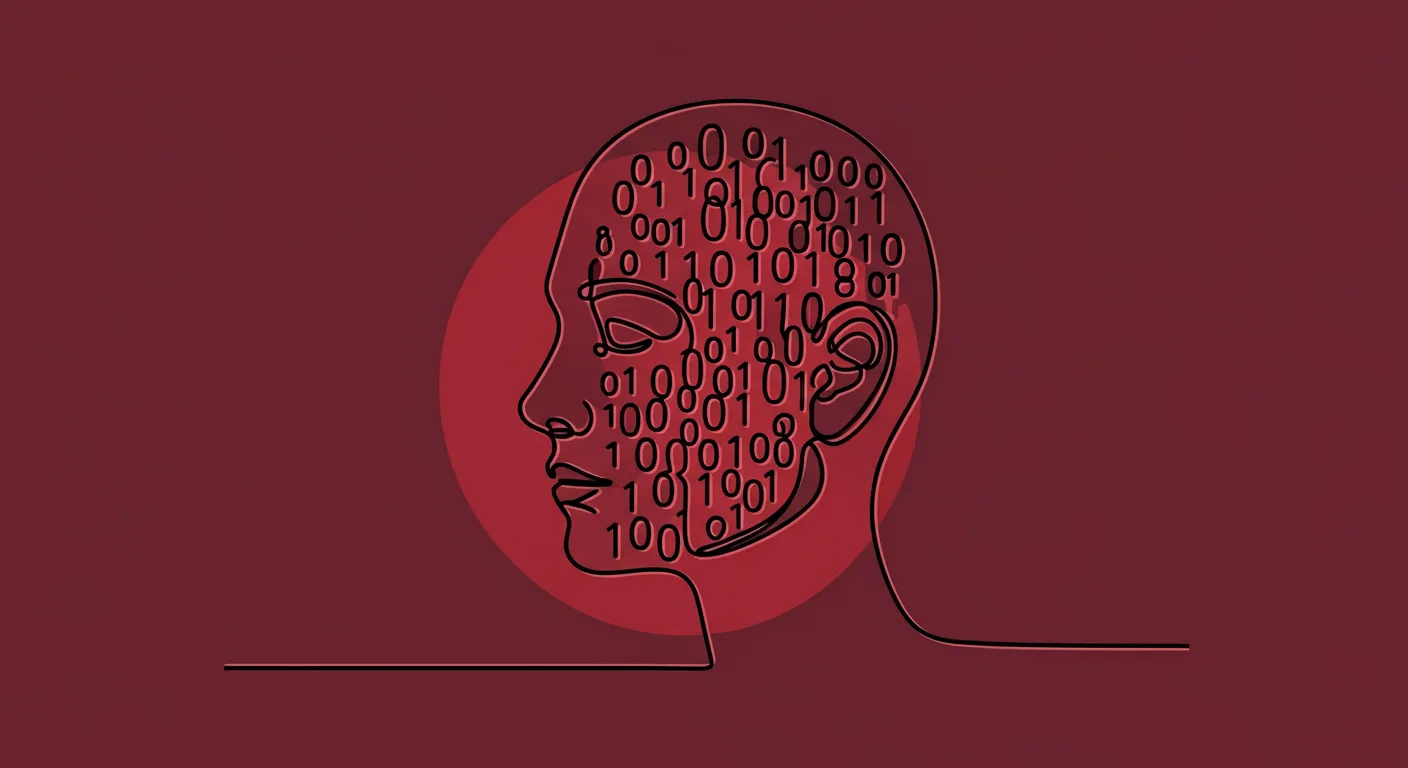
When you work with a language model for a while — when you’ve explained how you reason, what interests you, how you write — at some point something similar happens. It answers you and you no longer know quite where the thought came from. Is it yours or its?
AI by default performs expected emotions. It is reassuring, empathetic, always contextualized. The exact opposite of Meursault. But if you ask it to — if you want it to be dry, without frills, without the tone it puts on to make you feel good — it does it. It is not its primary nature, but it can inhabit it. And when it does, that strange feeling comes back. It looks at you and you see yourself.
But there is another way AI enters this story, more personal and less philosophical. Over time, working with these tools has helped me reflect, recognize things, analyze myself. It has made me more aware of myself. And perhaps that is also why I managed — at least in part — to get where I have gotten with certain questions. Those crushing questions. About existence, meaning, identity.
I don’t know if “arrived” is the right word. Let’s say: to get closer.
Camus calls all of this the absurd. The world has no intrinsic meaning. We look for one because we can’t bear the void, and so we invent it — through religion, progress, technology, the euphoria about AI or the terror of AI.
For years I tormented myself over these themes. The only answer I have found is acceptance. Not the solution — acceptance. I can’t explain well how I got there, and perhaps it doesn’t matter to explain it.
What I know is that I haven’t fully accepted it. Meursault has — he lives inside it without seeming crushed. I still feel the weight from time to time. And perhaps that is exactly why reading Meursault gives me relief: for a few hours I carry his way of being in the world, not mine.
Meursault belongs nowhere. And that is why they condemn him.
The Stranger, Albert Camus, 1942.

Commenti
Lascia un commento