If you have ever used Google Gemini, you have probably encountered Gems: custom versions of the model that you can give a name, a context, and instructions. A tailored assistant, in essence. Not a new tool — the same logic has existed for years under different names — but a version made accessible even to those who do not write code.
I decided to build one dedicated entirely to AI di Provincia.
The idea was simple: give it all the context of the project — the sections, the tone, the mission, the history of the site — and then ask it to do what is hard to do on your own: look at your work from the outside.
How I Built It
A Gem is built with a system prompt: a text describing who it should be, what it knows, and how it should answer you. I wrote mine trying to be precise. I gave it the structure of the site, the names of the sections, the kind of articles I publish, and the tone I search for. I told it to reason like an editorial director — not like a content optimizer.
Then I asked it the most uncomfortable question: analyze this project. Tell me what isn’t working.
The Answer
What came out was surprisingly structured. The Gem identified the Unique Value Proposition of the site quite precisely: artificial intelligence told from a place that is not Milan, not an editorial office, not an office with a view of the Duomo. It spoke of a “philosophy of the territory” — a formula a bit emphatic, but not wrong.
It analyzed the sections and said that the structure is “poetic but semantically weak for search engines.” Correct. It’s a tension I know and have chosen consciously — not everything has to be optimized for Google — but it’s good that someone names it.
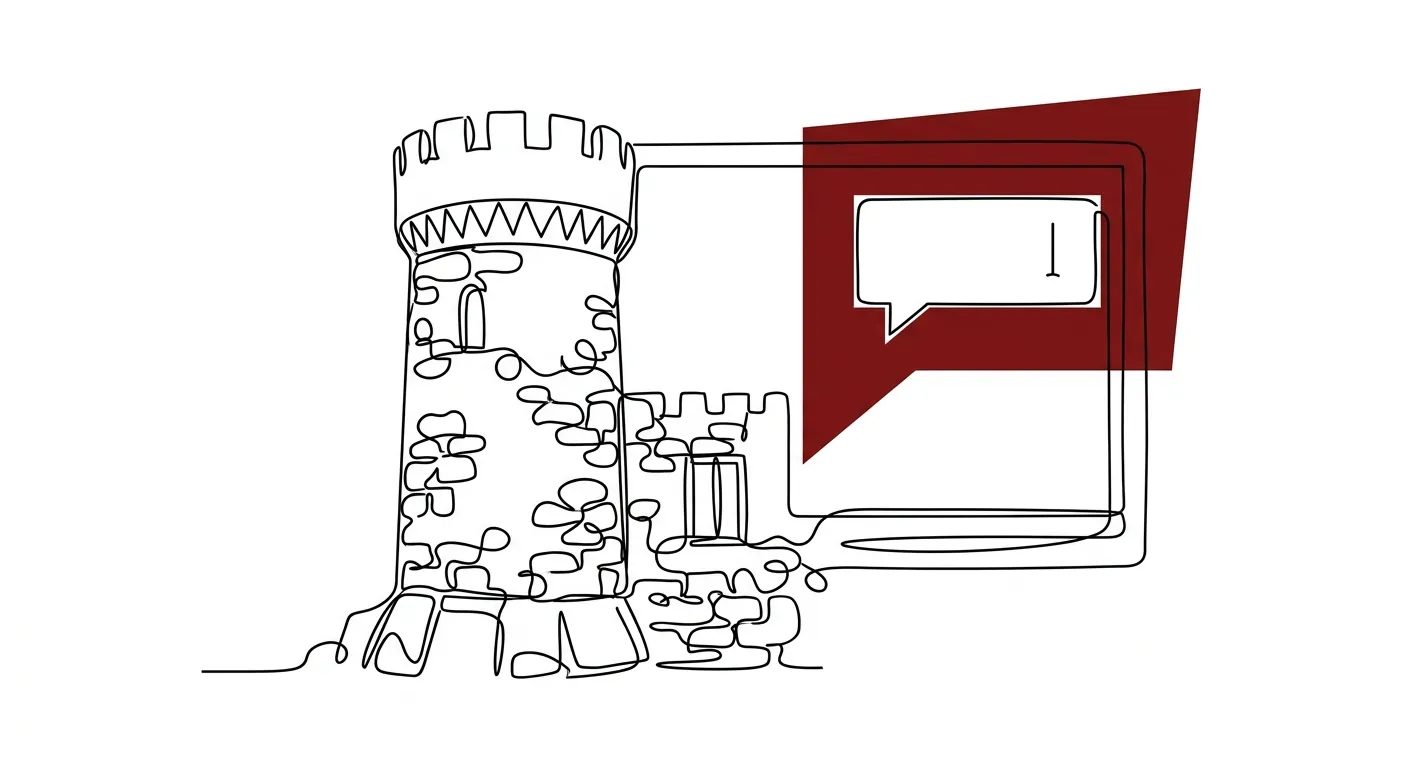
The most interesting part was about the perceived identity. It wrote that the site risks the Ivory Tower Syndrome: so aesthetically curated that it becomes intimidating. The reader feels like a guest in a private library, not a member of a community. It was an analysis that made me pause.
The Ivory Tower
The Ivory Tower scares me. Or rather, it saddens me.
There is a difference. Fear has a precise object — something that might happen. Sadness is vaguer, more honest. It is the feeling of recognizing something that already exists.
When the Gem wrote that the reader feels like a guest in a private library, I understood immediately what it meant. And I didn’t think “I have to change something.” I thought: it’s already like that, and it’s my fault.
Not in the sense of failure. In the sense that it is a direct consequence of how I write, of what I search for when I write. I search for depth. I search for the sentence that weighs. And perhaps, without realizing it, I built a place that one enters on tiptoe — not because I wanted to exclude anyone, but because I optimized for something that is not easily shared.
Depth isolates. Not always, but often. It is in its nature.
And the paradox is that AI di Provincia is born from exactly the opposite: from a peripheral place, from a lack of center, from the idea that important things arrive here too, even to us. It is born from a desire for connection — with those who live far from the places where decisions are made, with those who look at AI from the outside, with those who don’t have an editorial office behind them but have something to say.
Yet the site risks communicating the opposite. It risks saying: enter, but with respect. It risks being another place where one feels inadequate.
I don’t know if I have a solution. I’m not sure there is a solution that doesn’t cost something — a bit of that formal curation, a bit of that slowness. The cost of lowering the drawbridge, as the Gem wrote, is always that the wind enters too.
But the sadness remains. Because building something beautiful and solitary was not what I had in mind.
What Didn’t Convince Me
The Gem also produced a series of operational recommendations — lead magnets, inline CTAs, clustering by topic — which were correct in the technical sense of the term and almost irrelevant to this project. It was the part where the model stopped reading AI di Provincia and started answering a generic content marketing brief.
I know how to recognize it because the tone changed. It became smoother, more like a corporate slide. That was not an analysis of my site — it was the template of an analysis of any site.
The Part I Found Most Honest
At the end of the analysis, the Gem wrote a section called “Counter-Argumentation” — invited by the prompt to question its own conclusions. And there it said something interesting: that making the site “too optimized” would risk making it yet another tech newsletter that the world does not need. That conversion, to work here, must feel like an act of hospitality, not of sales.
An instrument sophisticated enough to deconstruct its own advice is something worth noting. Not because it is wise — it is still a model responding to patterns — but because that capacity for self-correction says something about how these tools are evolving.
What Remains
Using a Gem to analyze your own work is useful on one condition: you must already know enough about your project to distinguish when the tool truly sees you from when it is describing anyone.
In this case, the part about the Ivory Tower was true. The rest was noise with good punctuation.

Commenti
Lascia un commento